How to price your event tickets (with a worked example)
Safara One team ·
Pricing is where a lot of first-time organizers guess, and it's easy to guess too low. You don't need a spreadsheet to get it right. Add up what the event costs, work out how many tickets you need to sell, check what similar events charge, and then use a couple of simple tools to fill the room. Here's the whole method, with a worked example.
1. Add up what the event costs you
Split your costs into two kinds:
- Fixed costs — the same whether 5 or 50 people come: the venue, a co-facilitator or musician, equipment hire, insurance, and your own time. Put a real number on your time; if you leave it out, the event can look profitable while paying you nothing.
- Per-guest costs — what each extra person adds: materials, food and drink, printed handouts, a take-home gift.
Our example is a Saturday workshop for up to 25 people: $300.00 for the room, $250.00 for the organizer's time, and $8.00 per guest for materials and tea. That's $550.00 in fixed costs.
2. Find your break-even
Each ticket covers its own per-guest cost, and what's left goes toward the fixed costs:
Tickets to break even = fixed costs ÷ (ticket price − per-guest cost)
| Ticket price | Buyer pays on Safara One | Tickets to break even | Profit if 20 sell |
|---|---|---|---|
| $35.00 | $38.84 | 21 | −$10.00 |
| $45.00 | $49.33 | 15 | $190.00 |
| $55.00 | $59.81 | 12 | $390.00 |
| $65.00 | $70.30 | 10 | $590.00 |
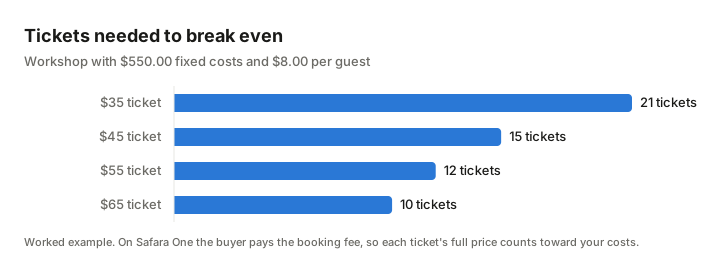
A cheap ticket feels safe, but it means you need a nearly full room just to get your money back — and a quiet week leaves you out of pocket. A higher price gives you room for a smaller crowd. As a rule of thumb, aim to break even at around half your capacity.
On Safara One the buyer pays the booking fee (4.3% + $1.90 per ticket, plus 13% HST on the fee) on top of your price, so the whole ticket price counts toward your costs. If you use a platform that takes its fee from your payout, subtract it from the ticket price before you do this sum.
3. Check what similar events charge
Your costs set the floor; the market sets the ceiling. Look up three to five events like yours — same kind of event, same city, similar length — and note their prices. If yours is well above them, make the difference obvious in your description: smaller groups, a longer session, materials included, live music, an experienced teacher.
Price for the value of the experience, not just the hours. A two-hour sound bath with a small group and quality instruments isn't the same product as a drop-in class, and it doesn't need to be priced like one.
4. Use tiers instead of one price
Two or three ticket types do more than a single price:
- Early bird — a lower price that stops selling on a set date. It rewards people who commit early and gives you an early read on demand. For example, $45.00 until two weeks before, then $55.00.
- General admission — your main price.
- Premium or supporter — a front-row spot, lunch included, a take-home kit, or simply "pay a little more to support the event".
On Safara One each ticket type has its own price and quantity, and the calendar icon next to it sets when that type stops selling — that's all an early-bird tier needs.
5. Use a discount code instead of lowering your price
If you want to give a group a better deal — members of your studio, a community you partner with, last year's guests — a discount code keeps your public price where it should be. Each event on Safara One can have one code, for a percentage or a fixed amount off each paid ticket.
For example, a $55.00 ticket with a 15% code: the buyer pays $46.75 plus the booking fee, $51.56 in total, and you receive $46.75. See Discount codes in the guide for how to set one up.
6. Free or paid?
Free works well for community gatherings, open days and first-time "taster" sessions. But a free RSVP costs nothing to ignore, so expect some people not to turn up and plan the room accordingly. Even a modest price is a commitment. If you go free, see free event ticketing for ways to help people actually come.
7. Revisit the price after each event
Your first price is a starting point. After the event, look at when tickets sold and whether you sold out. If the early-bird tier was gone in a day or the event sold out a week ahead, you can charge more next time. If sales only came in at the last minute, a stronger early-bird offer may help more than a lower price.
Questions
How much should I charge for a workshop or class?
Start from your own numbers: total your fixed costs (including your time), add per-guest costs, and choose a price that breaks even at about half your capacity. Then check that it sits sensibly against similar events nearby.
Should I include the booking fee in my ticket price?
On Safara One you don't need to: the buyer pays the booking fee on top of your price and you receive the full ticket price. Set the price you want to receive.
Should I offer refunds?
Ticket sales on Safara One are final, and buyers agree to that before they pay. If your guests might expect flexibility, say so clearly in your description.